Resources/Signs Your Business Is Ready for AI Automation
Signs Your Business Is Ready for AI Automation
AI automation isn't the right move for every business at every stage. Here's how to tell if you're actually ready, or if it's premature.
Series
Part of our AI Automation for Small Business: The Practical Guideresource series.
Published
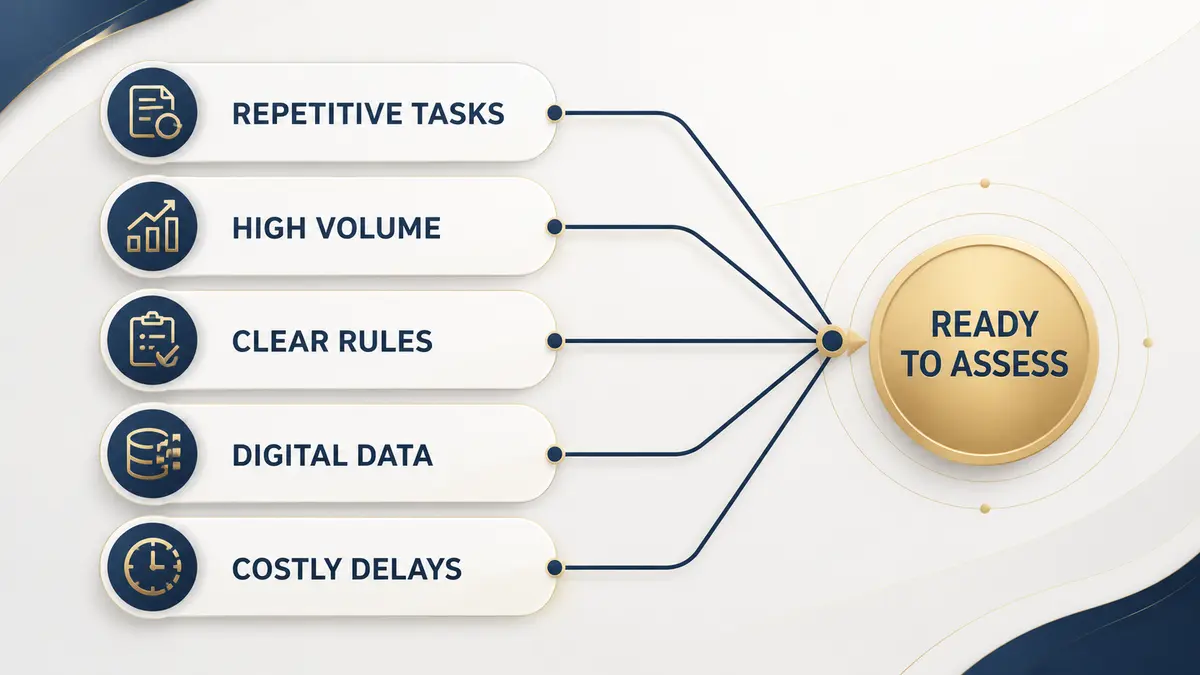
It's tempting to treat automation as something every business should just do. In reality, it's a good fit at some stages and premature at others, and building it too early usually means paying to automate a process that's still going to change next month. A few practical signs help tell the difference.
You have a repeatable process, not a one-off
Automation pays off when a process happens the same way often enough to be worth documenting. If you can describe the steps the same way twice, this is what happens when a lead comes in, this is what happens when an order ships, it's a candidate. If the "process" is really just whatever the most experienced person on the team improvises each time, there's nothing consistent yet to automate.
You have enough volume to justify it
Setting up automation takes real effort up front, mapping the process, connecting the systems, testing it against real inputs. If a task only happens a handful of times a month, the time saved may never catch up to the time spent building it. Volume is the single biggest factor in whether the math works out, more than the complexity of the task itself.
Your data lives somewhere structured enough to connect to
Automation needs something to connect to, a CRM, a form tool, a booking calendar, a spreadsheet with a consistent structure. If customer information is scattered across sticky notes, personal inboxes, and memory, there's a real prerequisite step (getting the basics into one structured system) before automation has anything reliable to work with.
You have someone who can own it after launch
“Businesses that treat launch as the finish line tend to watch their automation quietly drift out of date as the underlying process changes around it.”
Automation isn't a one-time install. It needs someone on the business side who understands roughly how it works, who gets flagged when something looks off, and who can request changes as the process evolves. Businesses that treat launch as the finish line tend to watch their automation quietly drift out of date as the underlying process changes around it.
Signs you're not ready yet
The clearest signs of prematurity: the process itself is still changing week to week, nobody on the team could confidently describe how a task is currently done, volume is too low to justify the setup effort, or there's no one who would actually own the system once it's live. None of these are permanent, they just mean the more useful next step is stabilizing the process itself before automating it, rather than automating something that's still being figured out.
Not sure which category you fall into? That's exactly what our Individual Consulting service is for.
Individual ConsultingContinue exploring
Resource
What's the ROI of Automating Customer Support?
A framework for sizing up the return before you commit, what actually drives ROI, what kills it, and how to estimate your own numbers.
Read itResource
AI Automation Agency vs. DIY Tools (Zapier, n8n, Make): Which Is Right for You?
The honest tradeoffs between hiring an agency and building it yourself with no-code tools, time, skill required, and who owns it when something breaks.
Read it