Resources/AI Automation Agency vs. DIY Tools (Zapier, n8n, Make): Which Is Right for You?
AI Automation Agency vs. DIY Tools (Zapier, n8n, Make): Which Is Right for You?
The honest tradeoffs between hiring an agency and building it yourself with no-code tools, time, skill required, and who owns it when something breaks.
Series
Part of our AI Automation for Small Business: The Practical Guideresource series.
Published
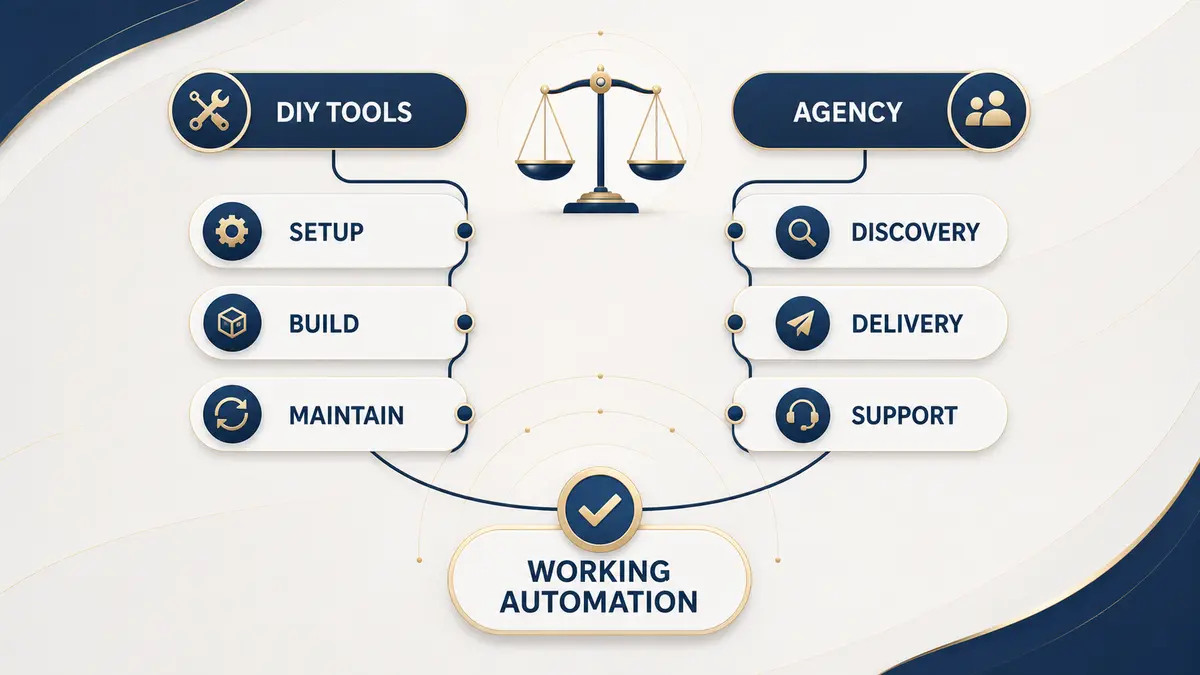
This isn't a question with one right answer, it's a question with a right answer for your specific situation. No-code tools like Zapier, n8n, and Make have gotten genuinely good, and plenty of businesses build real, reliable automation entirely in-house with them. Plenty of others burn weeks fighting a tool that was never quite built for what they're trying to do, and end up hiring someone anyway. Here's how to tell which camp you're actually in, disclosure up front: we're an automation agency, so weigh that accordingly, but we don't think DIY is the wrong answer for everyone.
Proof we mean that: we give away real workflow templates for free, no strings attached.
Automations LibraryWhat DIY no-code tools actually give you
Zapier, n8n, and Make are visual, node-based automation builders, you connect a trigger to a chain of actions across different apps without writing code. Zapier is the most polished and beginner-friendly of the three, with the largest library of pre-built app integrations. n8n is open-source and self-hostable, which appeals to technical teams who want full control and no per-task pricing ceiling. Make (formerly Integromat) sits in between, with a more visual, flowchart-style builder that handles complex branching well. All three genuinely work, and all three are things you or someone on your team can learn, the question is whether you have the time and the appetite to become the person who owns it.
What an agency actually gives you
Hiring an agency isn't buying different technology, under the hood, agencies frequently use the same tools (Zapier, n8n, Make, or custom code) that you could use yourself. What you're actually paying for is someone else's time: mapping your process correctly the first time, handling the edge cases that only show up once something is live, and being the one who gets paged when an integration breaks at 2am instead of you. It also means AI-specific work, training a system to correctly interpret unstructured customer messages, for instance, gets built by someone who's done it before, instead of being your team's first attempt.
| DIY (Zapier / n8n / Make) | Agency | |
|---|---|---|
| Time to launch | Depends entirely on your available hours and learning curve | Scoped and time-boxed in a proposal upfront |
| Technical skill required | You (or someone on your team) learns the tool | None, built for you |
| Ongoing maintenance | Your responsibility when something breaks or an app updates its API | Included as standard, not a separate line item |
| Complex branching / AI logic | Possible, but the learning curve gets steep fast | Handled as a normal part of the build |
| Cost structure | Tool subscription cost + your own time (often underestimated) | Project or retainer cost, no hidden time cost |
| Best for | A single, well-defined automation and a team willing to own it | Multiple or complex systems, or no spare in-house time |
See what a fully-managed build looks like across our service lines.
Our ServicesWhen DIY genuinely makes sense
If you have one clear, well-defined process to automate, a team member with the time and inclination to learn the tool, and the process is simple enough that it won't need heavy AI decision-making, DIY is a completely reasonable choice, and often the faster one, since there's no discovery call or proposal cycle to go through first. It's also the right call if you're still validating whether a process is even worth automating; building a quick version yourself before committing budget to a fully-built system is a sensible way to test that.
When an agency genuinely makes sense
An agency earns its cost when the automation spans multiple connected systems, involves AI interpreting unstructured input (a chatbot, a message classifier), or when your team genuinely doesn't have spare time to become the person who owns and maintains it. It also matters when reliability is non-negotiable, a broken internal automation is an inconvenience, but a broken customer-facing chatbot or booking flow is a lost customer, and that's a different bar for how carefully something needs to be built and tested.
The middle path most people miss
“Some of what you need really is a DIY job, and being upfront about that builds more trust than pretending otherwise.”
It doesn't have to be all-or-nothing. Plenty of businesses start with a DIY automation for the first simple process, hit a wall when the second or third one gets more complex or needs AI, and bring in outside help for that part specifically, while keeping the simple stuff running on their own. That's a perfectly reasonable way to grow into it, and it's part of why we publish free workflow templates ourselves: some of what you need really is a DIY job, and being upfront about that builds more trust than pretending otherwise.
Continue exploring
Resource
How AI Workflow Automation Works: A Practical Overview
The building blocks behind workflow automation, where AI actually earns its place in the process, and what implementation looks like in practice.
Read itResource
Signs Your Business Is Ready for AI Automation
AI automation isn't the right move for every business at every stage. Here's how to tell if you're actually ready, or if it's premature.
Read it