Resources/What's the ROI of Automating Customer Support?
What's the ROI of Automating Customer Support?
A framework for sizing up the return before you commit, what actually drives ROI, what kills it, and how to estimate your own numbers.
Series
Part of our AI Automation for Small Business: The Practical Guideresource series.
Published
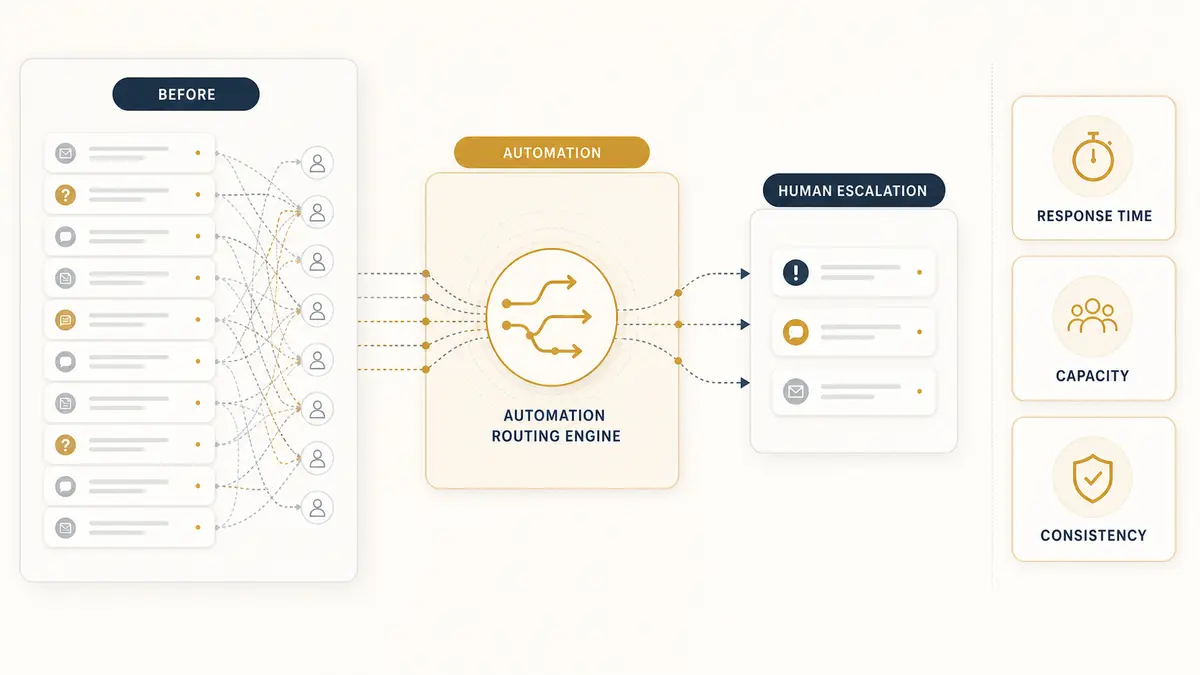
Every vendor in this space, including agencies, will hand you a case study with an impressive-looking number attached. Treat those cautiously, ROI on support automation varies enormously by business, and the honest answer to "what's the ROI" is: it depends on a handful of specific factors you can actually check for yourself before spending anything.
The direct cost side: time reclaimed
The most measurable part of ROI is time. If your team spends a meaningful chunk of the week answering the same handful of questions, order status, hours, pricing tiers, how something works, that's time that isn't going toward the conversations that actually need a human: complex issues, upsells, relationship-building. Automating the repetitive share doesn't just save time on paper, it reallocates your team's attention toward the interactions where a human actually adds value over a scripted answer.
This is the repetitive-question layer our Chatbot Development service is built to absorb.
Chatbot DevelopmentThe indirect side: response speed and coverage
The less obvious return is speed and coverage. A prospect who messages at 9pm and gets an immediate, useful response is more likely to convert than one who waits until the next business day, by then they've often already messaged a competitor. Automated first response doesn't need to close the sale; it needs to keep the conversation alive until a human can take over. That effect is real but harder to put a single number on, since it depends on how price-sensitive and time-sensitive your specific buyers are.
What makes ROI good versus poor
“A prospect who messages at 9pm and gets an immediate, useful response is more likely to convert than one who waits until the next business day.”
ROI tends to be strong when support volume is high enough that the setup cost is small relative to ongoing savings, when a large share of inbound questions are genuinely repetitive, and when there's a clean handoff path to a human for anything outside the automation's scope. ROI tends to be weak when volume is low (the setup isn't worth it yet), when most questions require real judgment or account-specific context, or when there's no clear escalation path, customers get stuck talking to something that can't actually help them, which damages trust rather than building it.
A simple way to estimate your own numbers
Before committing to anything, pull a rough estimate from your own data: how many support conversations do you handle in a typical week, how long does each one take on average, and what share of them are genuinely repetitive rather than requiring judgment or account-specific knowledge? Multiplying those three numbers gives you a real, business-specific estimate of hours potentially reclaimed, a far more reliable starting point than any generic industry benchmark, because it's built from your actual volume and your actual question mix, not an average across businesses that may look nothing like yours.
Common ways ROI gets killed
Continue exploring
Resource
Chatbot vs. Workflow Automation: What's the Difference?
Both live under the "AI automation" umbrella, but they solve different problems. Here's how to tell which one you actually need first.
Read itResource
Signs Your Business Is Ready for AI Automation
AI automation isn't the right move for every business at every stage. Here's how to tell if you're actually ready, or if it's premature.
Read it