Resources/Foundations and use cases/15 Practical AI Automation Examples for Small Businesses
15 Practical AI Automation Examples for Small Businesses
Fifteen concrete workflows organized by business function, with the trigger, action, human checkpoint, and result each one should improve.
Series
Part of our AI Automation for Small Business: The Practical Guideresource series.
Published
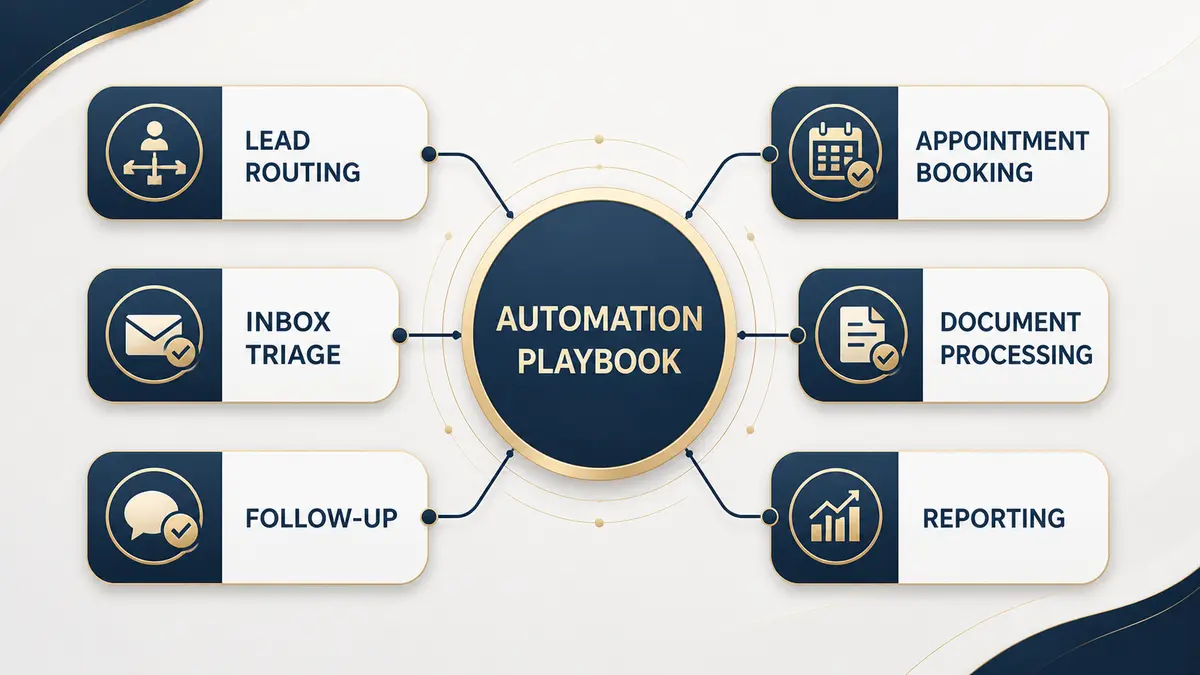
Useful automation examples are specific. They name the event that starts the workflow, the systems involved, the decision being made, and the point where a person should review the result. These examples are patterns, not promises; their value depends on your volume, data quality, and current process.
Lead generation and sales
Most small businesses lose leads not because they lack interest, but because a form submission sits in an inbox until someone has time to act on it. These four examples close that gap between an inbound signal and the first meaningful response.
Customer support and communication
Support automation earns the most trust when it is honest about its limits: it should resolve the predictable majority of requests quickly and route everything else to a person with full context, rather than trying to handle every case itself.
Appointments and service delivery
Scheduling and onboarding involve many small, repetitive steps that are easy to standardize because the rules rarely change, which makes this category one of the fastest to show a measurable time saving.
Operations, finance, and reporting
Back-office work rarely gets attention until it becomes urgent, which makes it a good automation candidate: the rules are usually well established, and the main risk is a delay or a missed step rather than a customer-facing failure.
Choose the first example carefully
| Question | Good signal | Warning signal |
|---|---|---|
| How often? | Daily or several times a week | Rare or highly seasonal |
| Stable process? | The team follows a common path | Every person handles it differently |
| Measurable? | Time, delay, error, or conversion baseline exists | No agreed outcome |
| Manageable risk? | Human review covers sensitive cases | Irreversible automated decisions |
| Clear owner? | A named person monitors results | Nobody owns exceptions |
Understand the building blocks behind every example.
How workflow automation worksTurn one example into a scoped implementation.
Implementation guideContinue exploring
Resource
How AI Workflow Automation Works: A Practical Overview
The building blocks behind workflow automation, where AI actually earns its place in the process, and what implementation looks like in practice.
Read itResource
Customer Service Automation: A Practical Guide
A complete view of support automation, from the first message to resolution, escalation, records, and quality measurement.
Read itResource
CRM Automation 101: Connecting Your Tools Without the Manual Work
What CRM automation actually covers, why disconnected tools are the real underlying problem, and what a well-automated pipeline looks like end to end.
Read it