Resources/Chatbots, language, and model quality/The Latest AI Model Is Not Always the Best Model for Your Task
The Latest AI Model Is Not Always the Best Model for Your Task
I have kept GPT-4.1 and GPT-4o in production tasks when they produced fewer errors than newer models. Release date is not an evaluation metric.
Series
Part of our AI Automation for Small Business: The Practical Guideresource series.
Mohamed Amine Saada, Forteuno Web
Published
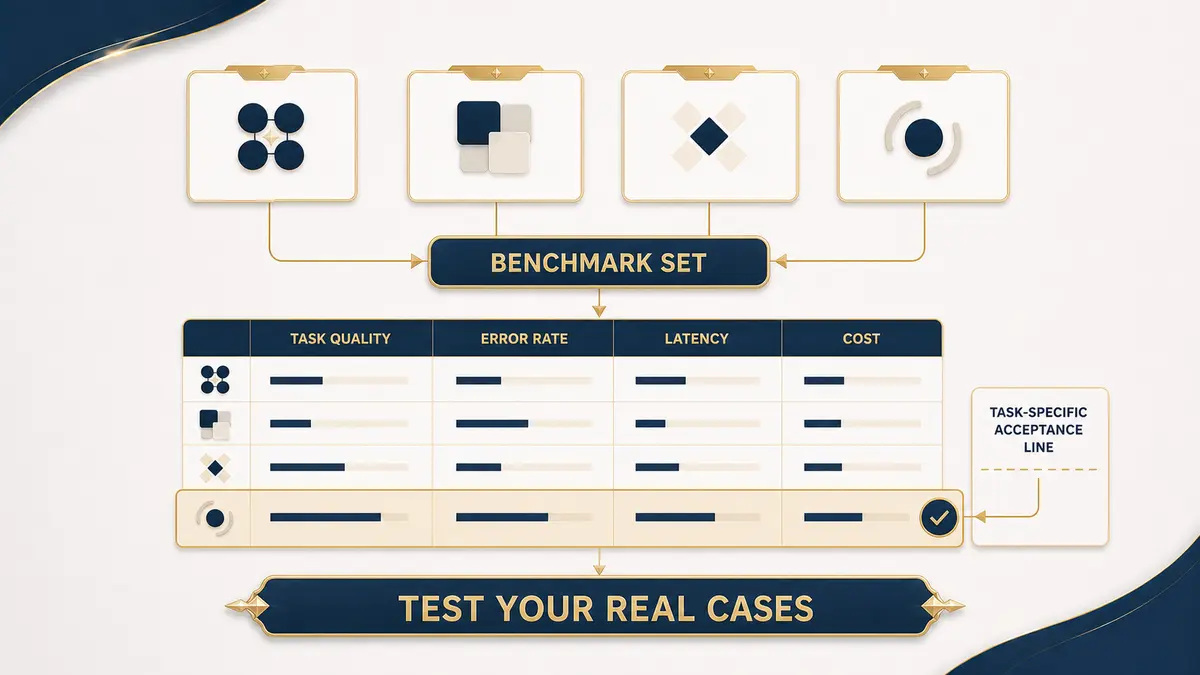
New model releases create pressure to upgrade immediately. I do not treat a newer model as an automatic production improvement. In two SaaS projects, GPT-4.1 and GPT-4o gave me better task results and a lower practical error rate than newer alternatives I tested. That is not a universal ranking. It is exactly the point: model quality depends on the task, prompt, tools, language, latency target, and failure cost.
Benchmark the job you are buying the model to do
Public benchmarks can tell you about broad capabilities. They cannot tell you whether a model handles Moroccan Darija appointment requests, returns your exact JSON schema, calls the correct clinic tool, or follows your escalation policy. Build a private evaluation set from representative cases and run every candidate against the same inputs.
Use language- and domain-specific benchmarks, not general ones
General leaderboards are close to useless for a task like Moroccan Darija support. They mostly measure English performance with some multilingual coverage attached, and dialect quality does not show up in an aggregate score. Purpose-built benchmarks exist for exactly this gap: the Arabic LLM Broad Leaderboard specifically tests dialect and script variation, and a curated Arabic NLP resource list is a faster starting point than searching model cards one by one. The same principle applies outside Arabic. If your task involves a specific language, domain, or regulatory constraint, find or build a benchmark for that constraint before trusting a general leaderboard rank.
Use frozen model versions for a fair comparison
Test specific model snapshots when the provider supports them. A moving alias can change behavior during your comparison. Save the prompt, parameters, tool definitions, retrieved context, and expected output. Otherwise a model upgrade, prompt edit, and retrieval change can happen together and you will not know what caused the result.
Do not average away serious failures
A model can score well overall and still fail the one category that matters. For a dental support assistant, an awkward greeting is less serious than inventing medical advice or confirming an appointment that was never booked. Give critical cases their own acceptance threshold. Review failures by category rather than hiding them inside one average score.
OpenAI model names are capability labels, not your production verdict
OpenAI currently lists GPT-5 family models alongside GPT-4.1 and GPT-4o families, with different positioning for reasoning, speed, multimodal work, and cost. The platform also provides evals that can run test criteria against model configurations. Use those capabilities as candidates. Your evaluation decides which candidate belongs in the workflow.
Re-test when something meaningful changes
Run the benchmark when you change the model, prompt, examples, tools, retrieval source, or output schema. Keep a small regression set in your deployment process. The newest model may win later. It should earn that migration with evidence.
Decide whether the failure needs examples, fine-tuning, or heavier adaptation.
Prompting vs. fine-tuningOptimize model cost only after the result is dependable.
Quality-first optimizationContinue exploring
Resource
How to Make an AI Chatbot Understand Moroccan Darija and Other Dialects
I almost fine-tuned a local model for Moroccan dental support. Real examples written by experienced clinic assistants solved the harder problem first.
Read itResource
Few-Shot Prompting vs. Fine-Tuning vs. Training: Which Fix Do You Need?
Technical teams often jump to fine-tuning too early. A small set of excellent examples can fix tone, format, tool use, and edge-case handling without changing model weights.
Read itResource
Build for Quality First, Then Optimize AI Automation Cost
Trying to maximize quality and minimize cost at the same time makes debugging harder. I establish the best result first, freeze the benchmark, then make it cheaper.
Read it