Resources/Tools and partner selection/Best AI Workflow Automation Tools for Small Business
Best AI Workflow Automation Tools for Small Business
A practical tool guide organized by business fit, ownership, complexity, data control, and maintenance instead of a universal ranking.
Series
Part of our AI Automation for Small Business: The Practical Guideresource series.
Published
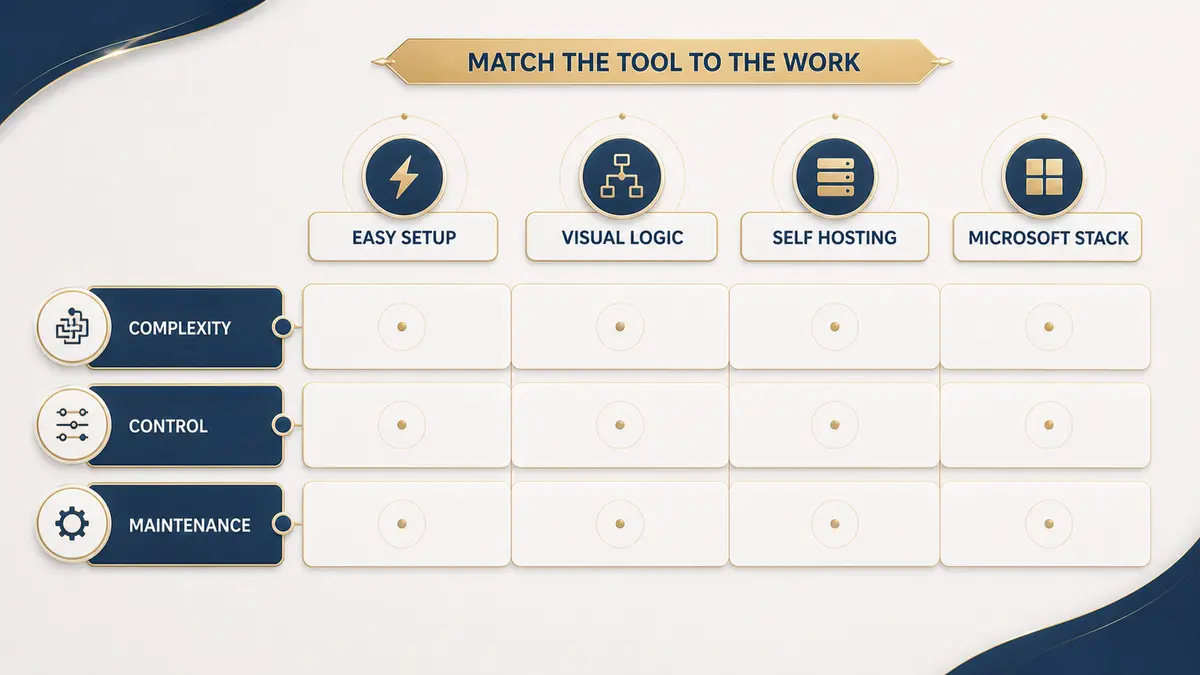
There is no single best automation tool for every small business. The right choice depends on who will own the workflow, which applications need to connect, how complex the logic is, where data may be processed, and how much maintenance the team can absorb. Most "which tool is best" questions are really "who owns this after launch" questions wearing a different name, and answering the second question first tends to make the first one much easier.
A practical shortlist
| Tool type | Strong fit | Watch for |
|---|---|---|
| Zapier | Fast setup, broad app coverage, straightforward workflows | Task-based cost and very complex branching |
| Make | Visual multi-step scenarios and data transformation | Steeper learning curve and maintainability |
| n8n | Custom APIs, self-hosting, and complex logic | Requires technical ownership |
| Power Automate | Businesses centered on Microsoft 365 | Licensing and connector complexity |
| HubSpot workflows | Sales and marketing inside HubSpot | Best within its own ecosystem |
| Native automation | Simple workflows inside one platform | Limited across several systems |
Evaluation criteria that matter
Use AI only where it adds value
Use AI for bounded interpretation: classifying messages, extracting fields, summarizing context, or drafting for review. Keep calculations, permission checks, required-field validation, and irreversible actions deterministic. A useful rule of thumb: if you could write the logic as a clear if/then rule without losing accuracy, do that instead, and save the AI step for the part of the workflow where the input genuinely varies too much for fixed rules to cover.
Run a representative proof
Build one workflow with realistic volume and exceptions. Force a failure and test whether the owner can understand and recover it. A tool that is impressive in a demonstration but difficult to debug can create more burden than it removes. The most revealing test is rarely the happy-path demo everyone shows first: it is disconnecting an API mid-run, feeding it a malformed record, and watching whether the team can diagnose what happened without outside help.
Compare the main independent builders directly.
Zapier vs. Make vs. n8nDecide who should own the build.
Agency vs. DIYStart with requirements before choosing a platform.
Implementation guideContinue exploring
Resource
Zapier vs. Make vs. n8n for Small Business Automation
A fair comparison of three workflow builders based on who will own the system and what the process actually requires.
Read itResource
AI Automation Agency vs. DIY Tools (Zapier, n8n, Make): Which Is Right for You?
The honest tradeoffs between hiring an agency and building it yourself with no-code tools, time, skill required, and who owns it when something breaks.
Read itResource
How to Implement AI Automation in Your Business
A practical implementation process from selecting the workflow through testing, launch, ownership, and ongoing monitoring.
Read it