Morocco/Guides/How do you get your first patients when you open a dental practice?
How do you get your first patients when you open a dental practice?
Qualification, selective consultations and follow-up: a concrete system for getting your first patients when you open a dental practice.
Dossier
Guide generated from validated data for this specialty. See all guides.
Mohamed Amine Saada, Forteuno Web
Published
Editorial status: Educational content. To be validated by the medical professional and per applicable board rules before publication or a campaign.
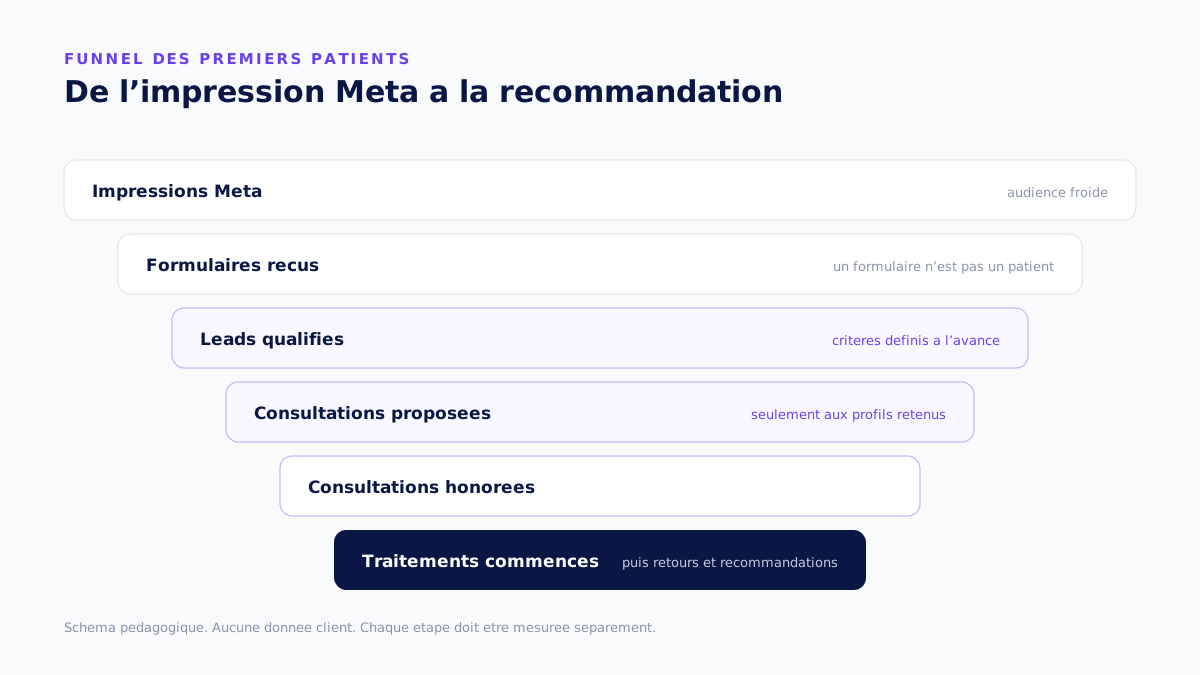
You’ve just opened your dental practice and your chair sits empty part of the day. The problem is almost never your clinical skill: people who need a dentist don’t know you exist yet, and those who find you hesitate because they picture the pain and the price before they picture the result.
What I observe in the field
Working with dental practices, I’ve seen the same scene repeat itself: the ad produces form submissions, the team calls back two days later, and the practice concludes the ad doesn’t work. The problem was after the form, not in it.
The patient’s journey before the solution
The questions your patients are already asking
What changes for your specialty
In dentistry, the first consultation mainly turns a worry into an understandable pathway. The patient should leave knowing how many sessions are planned, what will happen at the first one, and what still depends on the exam. SmileGen can open the cosmetic conversation, but it remains a pre-consultation visualization, never an outcome promise.
Your specialty also has a natural advantage when you publish useful content:
Qualifying a request without making a diagnosis
Qualification means understanding what the request is about, not assessing a clinical situation remotely. For your specialty, the useful categories are the following:
The plan to apply
Frequently asked questions
Do we need written procedures before starting?
We don’t start by installing a generic tool. We first map the requests, the approved information, the qualification questions, the medical boundaries, and the practice’s escalation rules. A team with no procedures that doesn’t want to formalize them isn’t ready for this step, and we’d rather not deploy in that case.
Should the ad mention a free consultation?
No. Advertising a free offer mainly attracts people interested in the free part itself. The ad should speak to the patient’s need, and any benefit is only offered after qualification, to profiles decided in advance.
Where does what the content or the agent can handle stop?
No diagnosis or outcome promise online. SmileGen remains a visualization and pre-consultation tool, never a treatment plan or a guarantee.
Cold leads and warm leads
On Google, the person is already searching. On Facebook or Instagram, they discover your message while looking at something else. The second is often called a cold lead. That doesn’t mean it’s a bad one, only that it needs more explanation before deciding.
A cheaper lead isn’t automatically a profitable one. The cost of the form says nothing about qualification, showing up for the appointment, or actually starting treatment.
The reasoning is statistical
You’re not reasoning about one exceptional patient. You’re reasoning about a group. Some requests will be qualified, some will show up, some will start treatment, and some will recommend the practice.
The basic math stays simple: patients obtained equals requests multiplied by the qualification rate, the show-up rate, and the start rate. Then compare that result to ad spend, team time, and the cost of any free steps offered.
“Educational content. Check the rules that apply with your regional professional board before any publication or campaign. No Google ranking can be guaranteed.”
Continue exploring
Resource
Nouveau cabinet médical au Maroc : comment attirer ses premiers patients ?
Trois actifs complémentaires pour un cabinet ouvert depuis moins de deux ans : une présence pédagogique, un site utile et un parcours de contact bien organisé.
Read itResource
Comment obtenir vos premiers patients grâce au digital quand vous ouvrez votre cabinet ?
Une publicité produit des formulaires, pas des patients. Voici le chemin complet entre une personne qui découvre votre cabinet et une personne suffisamment rassurée pour commencer une prise en charge.
Read itResource
Pourquoi vos demandes digitales ne deviennent-elles pas des rendez-vous et comment les convertir ?
Le problème se trouve souvent après le clic : réponse tardive, questions improvisées, absence de statut ou confusion entre qualification et conseil médical.
Read it